
An ant trail in your kitchen is easy to dismiss. A carpenter ant colony working through your wall framing is not. Ant infestations in Alaska range from surface-level nuisances to structural threats, and the difference between the two is not always obvious at first glance. Most homeowners treat the trail and assume the problem is resolved, only for it to return a week later from a different direction.
At Eagle Pest Control, we have spent more than 23 years identifying and eliminating ant colonies across Southcentral Alaska. This piece covers the species most commonly found in this region, what drives the cost of professional ant control, and what effective treatment actually involves.
Ant activity inside a home is rarely limited to what you can see. Understanding the full picture changes how urgently the problem deserves attention.
The ants you see on your counter or floor are workers sent out to find food and water. The colony, including the queen and the bulk of the population, is elsewhere entirely. Eliminating foragers without reaching the nest produces no lasting result, and the cycle repeats until the colony itself is addressed.
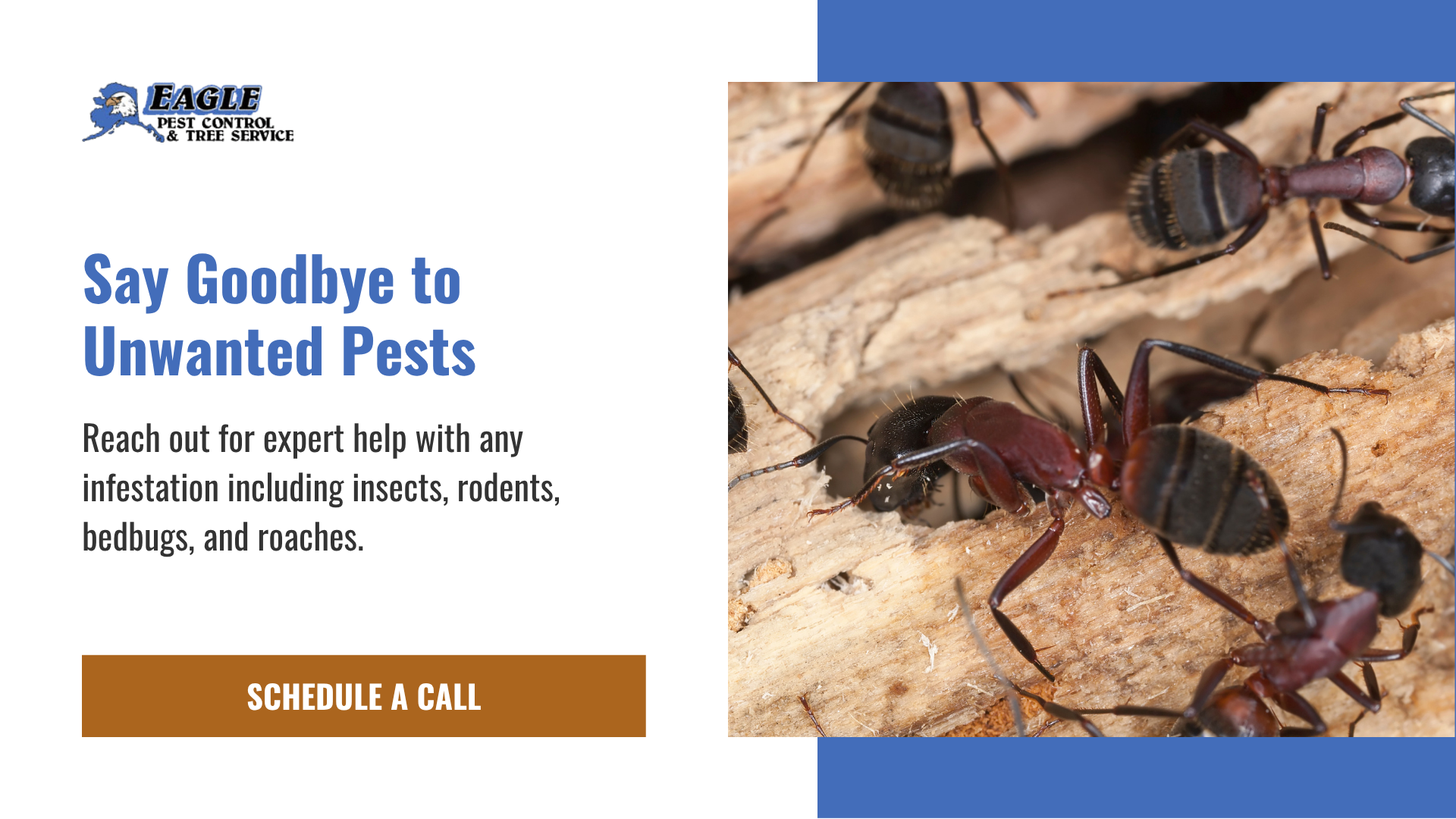
Among the species active in Southcentral Alaska, carpenter ants carry the most serious long-term consequences. They excavate wood to build nesting galleries, preferring material already softened by moisture. The damage accumulates inside walls, floor joists, and roof structures, invisible until the structural impact becomes significant.
Repellent sprays cause many ant species to split colonies and scatter. One concentrated infestation becomes several dispersed ones, each establishing new foraging routes through different parts of the home. Every failed treatment attempt makes the infestation harder to resolve professionally afterward and more expensive.
Alaska’s climate supports several ant species that regularly enter homes and businesses. The species present determines everything about how treatment should be approached.
Understanding ant control costs before calling a professional helps set realistic expectations. Several factors shape both the treatment and its cost.
Carpenter ant infestations involving structural nesting require more comprehensive inspection and treatment than surface-level pavement ant activity. Ant removal cost reflects this difference in scope directly, and getting the identification right from the start avoids wasted treatment on the wrong approach.
A recently established colony is more straightforward to treat than one that has had a full season to build satellite nests across multiple areas. Homeowners who contact us early consistently face lower overall costs.
Properties dealing with other pests alongside ants can schedule our roach removal inspection at the same time to address multiple concerns efficiently.
Homeowners who factor in the cumulative expense of repeated over-the-counter treatments, plus structural repair costs from unaddressed carpenter ant damage, consistently find that professional treatment earlier in the process is the more cost-effective path. How much to exterminate ants on a given property depends on the species, spread, and structural variables that our inspection clarifies upfront.
Knowing what the process looks like helps you evaluate whether a provider is actually doing the job properly.
Every job starts with a full property inspection. We identify the species, trace foraging trails, locate the colony and any satellite nests, and assess the conditions supporting the infestation. Homeowners ready to move from research to scheduling can book directly through our ant exterminator service page.
We apply products that work through a transfer mechanism. Ants that contact the treatment carry it back to the colony and pass it on through normal contact with other workers, reaching the queen and core population that direct application cannot access.
For properties managing both ant and wasp activity, our wasp nest removal service covers exterior stinging insect concerns across the same service areas.
The parent colony is almost always located outside the structure. Treating the exterior perimeter interrupts foraging trails and reduces pressure from the outdoor colony, limiting re-establishment of satellite nests inside. Skipping this step is a common reason ant problems return after initial treatment.
After treatment, we monitor the property to confirm the infestation has been fully resolved. Properties also managing other pest pressures can schedule our consultation to Get Rid of Ants alongside any additional inspections to keep everything coordinated.
Ant infestations in Alaska range from a minor inconvenience to a structural problem, and the difference between the two often comes down to how quickly professional treatment is sought.
At Eagle Pest Control, we are Alaskans serving Alaskans. We have spent more than 23 years treating ant infestations across Anchorage, Eagle River, the Mat-Su Valley, and the Kenai Peninsula, and every job starts with an honest inspection rather than a generalized solution. If an ant activity is affecting your property, call us today. Seven days a week, 8 AM to 8 PM.
Carpenter ants are large, dark, and most active at night. Finding coarse sawdust-like debris near wood is a strong indicator that warrants professional inspection.
Carpenter ants can. They excavate moisture-damaged wood to build nesting galleries, and unchecked colonies cause significant structural damage over multiple seasons.
Sprays eliminate foragers but leave the colony intact. Scent trails remain active, and new workers follow them back to the same locations until the nest is addressed.
Yes. We select products appropriate to the situation and apply them in a targeted manner. Our team advises on any precautions specific to your household before treatment begins.
Yes. Effective ant control addresses both the interior satellite nests and the exterior parent colony. Treating only one without the other produces incomplete results.
Most treatments are completed in a single visit. Larger infestations or those with extensive satellite nesting may require follow-up to confirm full colony elimination.
Spring through summer is peak season as colonies expand after winter. Carpenter ant swarmers appearing indoors in spring indicate an established colony that has been active for some time.

Talk with our specialists and get a customized treatment plan.